
Discomfort and unsafety
I was at a weekend workshop recently and one of the facilitators said that, while she hoped this would be a safe space, she also asked us to anticipate feeling uncomfortable.
I really appreciated her naming this dichotomy; it’s one I think about a lot in terms of therapy, as I often see safety and comfort conflated. Therapy is supposed to be validating, cozy. It’s supposed to feel good. And, like, I don’t want people to feel bad in therapy…
But feeling good is actually not what therapy is for.*
The desire to be safe is real.
All living organisms want to move away from threat and toward safety. And of course, I think often of boygenius’s lyric: “not everybody gets to live a life that isn’t dangerous.”
Ever getting to feel safe is not to be taken lightly.
But being free from harm isn’t the same thing as feeling good.
More recently I’ve been trying to push my literary horizons by reading poetry. Reading Keats and Tennyson is a struggle at times, because I’m not used to it, and I’m definitely missing things, and it also pushes me out of my little arena where I can feel “smart.” It’s not as comfortable as the things I normally read, but Idylls of the King isn’t actually harmful.
The problem with seeing comfort as safety is that it can really keep us stuck.
Sometimes the safety we run to is temporary. OCD tells us that rituals and compulsions are the way to stay safe, but they keep us in loops. Challenging beliefs like:
“I get to take up space”
“my needs matter,” or
“I don’t have to wait for everyone else to be ok to make changes in my life”
is often deeply uncomfortable. It’s easier to just keep on shouldering everything.
My fellow perfectionists know how the discomfort of Not Being Good At It Right Away can keep us boxed in as well. Directly approaching the traumas that put your whole being on alert is hella hard, and yet we know that exposure based treatments are the most effective trauma treatments therapists have.
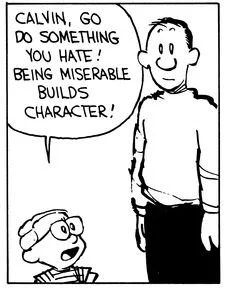
To be clear, I’m not advocating for going into discomfort for the sake of discomfort. It’s not like the Calvin & Hobbes strips where Calvin mimics his dad saying “being miserable builds character.” The discomfort is only worth it if it’s in line with your goals and values.
Clients have the power and the right to make that call, not the therapist. (Though I may try to argue my case for working on something in therapy, it’s ultimately not up to me.)
I chose to challenge myself to understand poetry better, because I think it’s a worthwhile intellectual challenge.
If you are terrified of planes and also actually are not interested in traveling long distances, I’m not going to say you should spend your precious limited time doing exposures to feel comfortable with flying. But if your sister has moved halfway around the world and you want to visit her, it might be worth pushing against the discomfort you have with flying. (Or the terror. Let’s be real. Discomfort is a pretty mild word.)
If you are haunted by the persistent feeling of never being actually good, it might be worth moving toward that relational trauma to get some freedom from those thoughts and emotions.
You can be uncomfortable and do the work.
*I do actually think therapy should feel validating, but in the specific DBT sense of things making sense given someone’s history, interpretations, experiences, values, etc not an unending stream of “you are so right, girl, and everyone else sucks.”