
Continuing Education
BEYOND 101: FRESH TOOLS TO USE IN THE FIELD WITH NUANCE, HEART, HUMOR
Practical, neurodivergent-affirming CE tools for complex clinical work
This is continuing education for clinicians who want more than another dry, surface-level training.
My workshops give you the goods, i.e. tools you can put into immediate action in your next session, while still holding the nuance that complex clinical work requires.
My main jams are DBT and neurodivergence, especially where they intersect with trauma, chronic invalidation, BPD, autism, ADHD, AuDHD, and multi-diagnostic clients.
My goal is not to teach clinicians “The Way” — mostly because it doesn’t exist.
It’s to help them build stronger paradigms for clinical decision-making, so they can feel more confident (or at least less stressed) when working with clients who do not fit neatly into one diagnosis, one protocol, or one tidy treatment plan.
And yes, we have fun, too.
As one attendee put it, my CE was “the least dry introduction to DBT I could imagine.”
Another appreciated that my workshops are all that and a bag of chips:
"Finally, something that goes beyond 101.”
Because complex clients need more than one-size-fits-all answers, and clinicians deserve more than bored-to-tears trainings.
Latest courses available on-demand
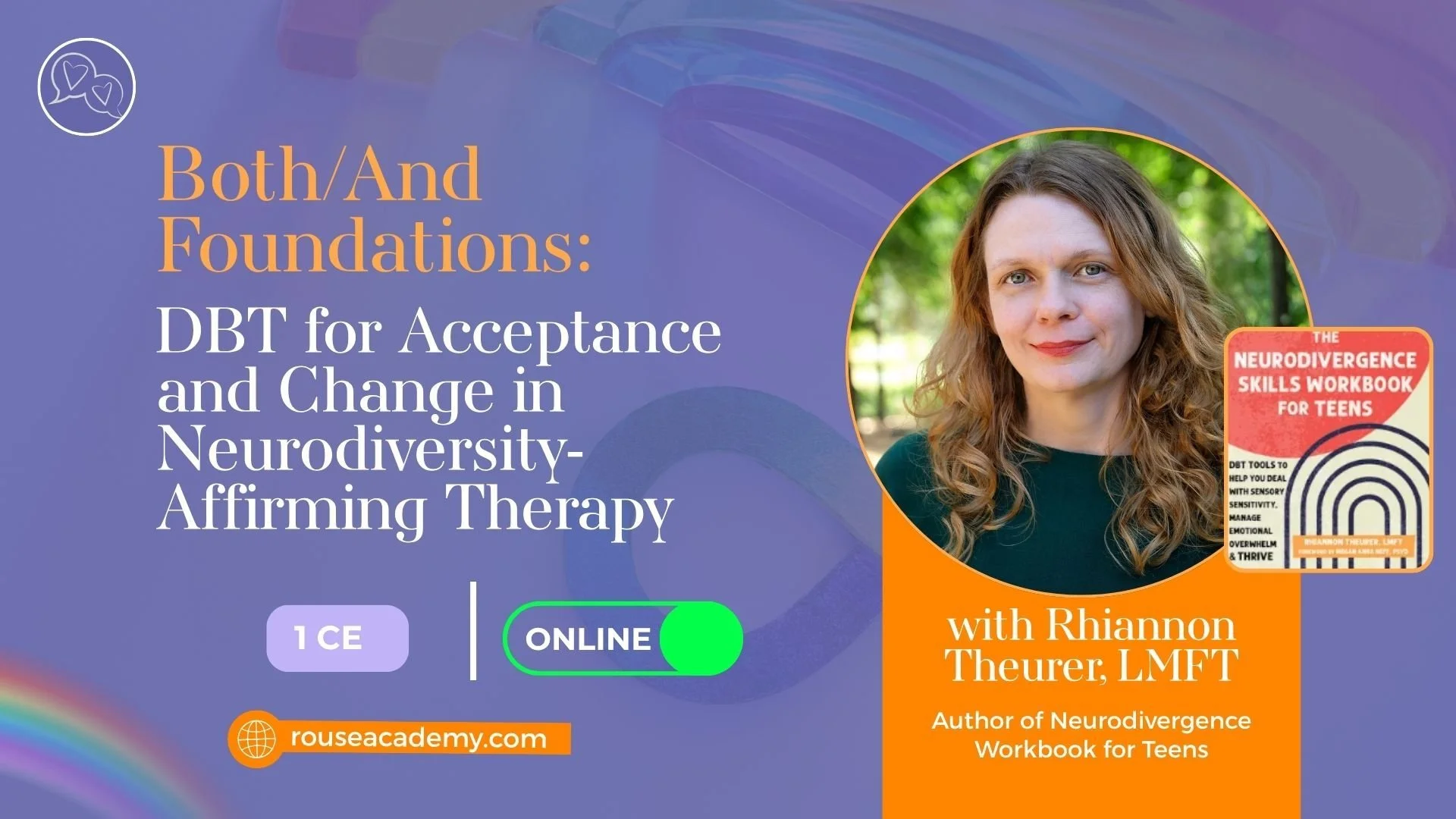
Both/And Foundations: DBT Approach to Acceptance & Change in Neurodiversity-Affirming Therapy
Recorded date: May 29, 2026
Provider: Rouse Academy: Advanced Continuing Education on Couples & Sex Therapy
CE Approval: Approved by CEPA #1000132, for California LMFTs, LCSWs, LPCCs, and LEPs
Level: Introductory/Beginning - no prior knowledge of DBT or neurodivergence required
Course Description
The neurodiversity paradigm has been transformative for many clients and clinicians alike. Recognizing that neurodivergent individuals are not inherently broken, but rather navigating a world not designed for how their brains and nervous systems work, has offered profound relief and validation. At the same time, clinicians often find themselves caught between old models of pathology and newer affirming frameworks, uncertain about how to help clients pursue meaningful change while remaining genuinely neurodivergent-affirming.
Both/And Foundations introduces clinicians to a dialectical approach rooted in Dialectical Behavior Therapy (DBT) that holds acceptance and change simultaneously. Drawing on Linehan's dialectical framework and neurodiversity-affirming principles, this training offers practical clinical tools that can be applied across therapeutic modalities. No prior knowledge of DBT or neurodivergence is required. This course is appropriate for therapists across licensure types and practice settings who work with or are interested in working with neurodivergent clients.
This course is introductory in level. It does not assume familiarity with DBT or the neurodiversity affirming paradigm, but it goes beyond a definitional overview to offer concrete skills and case-based application.
Educational Goals
This training is designed to expand clinicians’ capacity to work effectively and ethically with neurodivergent clients by integrating a dialectical perspective into affirming clinical practice. Participants will develop a foundational understanding of dialectics and their application to the tensions inherent in neurodivergent-affirming change work. Clinicians will leave with greater confidence in walking the middle path — validating neurodivergent identity and experience while supporting clients in pursuing goals that are meaningful to them.
Specifically, this course aims to:
Build familiarity with the dialectical worldview and its relevance to neurodivergent-affirming therapy
Introduce DBT-informed skills that support both acceptance and goal-directed change
Strengthen clinicians’ ability to conceptualize and hold the social and cultural context shaping neurodivergent clients’ self-perceptions
Increase clinician confidence in supporting client change without pathologizing neurodivergent identity
Measurable Learning Objectives
At the conclusion of this training, participants will be able to:
Explain what dialectics are and apply dialectical thinking to at least two specific clinical challenges commonly faced by neurodivergent clients
Describe at least three social and cultural factors that influence neurodivergent clients’ views of self, including the impact of societal norms that pathologize neurodivergence
Apply four DBT-informed skills — radical acceptance, effectiveness, values clarification, and interpersonal effectiveness goal-setting — to support neurodivergent clients in making desired changes
Distinguish between therapist behaviors that reinforce pathologizing frameworks and those that reflect neurodivergent-affirming practice, using case examples to illustrate the difference
References
The following references are submitted in APA 7th edition format and correspond directly to the learning objectives and course content:
Linehan, M. M. (2015a). DBT skills training handouts and worksheets. The Guilford Press.
Linehan, M. M. (2015b). DBT skills training manual (2nd ed.). The Guilford Press.
Theurer, R. (2025). The neurodivergence workbook for teens. New Harbinger.
Wise, S. J. (2026). The neurodivergent friendly workbook of DBT skills (2nd ed.). Lived Experience Educator.

Core expertise & topics
I teach at the intersection of DBT, neurodivergence, and clinically complex / multi-diagnostic clients.
My favorite CE territory is the stuff that rarely fits neatly into one training, diagnosis, or protocol. You know, all the people and problems that show up in the actual clinical work? Helping clinicians navigate that confidently, with their own paradigms for practice instead of someone else’s, is kinda my thing. These topics include:
DBT and neurodivergence
Complex, multi-diagnostic clients
BPD, autism, ADHD, and AuDHD overlap
All trainings can be adapted for clinicians who are brand new to these topics, clinicians with more advanced DBT experience, or teams looking for something that finally goes beyond 101.
Basically: if your clinicians are working with complicated humans and need something more useful than a neat little worksheet, this is my lane.